Parking Garage Painting
A parking structure doesn't have the sun doing half the work. Every line, arrow, and number has to create its own contrast under artificial light, on a concrete surface that wears differently than an outdoor lot — that changes what "visible" actually requires.
Striping for Artificial Light and Tight Turns
A garage layout has to account for how people actually drive and see inside a structure — slower, in tighter turns, under fixed lighting that never changes with the time of day.
- Assess the concrete surface. Garage decks are typically bare or sealed concrete rather than asphalt, which changes how paint bonds and how much prep the surface needs before striping.
- Lay out lanes and stalls for low light. Lines and stall markings are painted in high-contrast colors — sometimes with reflective additive mixed in — so they read clearly under fixed artificial lighting instead of daylight.
- Mark ramps and blind corners. Directional arrows and lane lines get extra attention at ramps, tight turns, and blind corners, where a driver has the least time to react to another vehicle or a pedestrian.
- Add level and zone wayfinding. Painted level numbers or zone letters at entrances and stairwells help drivers remember where they parked — a problem unique to multi-level structures.
- Paint for scrub wear, not just roll wear. Tight turning radii mean tires scrub sideways across paint at ramps and corners far more than they do on a straight run of outdoor stalls, so those areas are painted to hold up to that specific kind of abrasion.
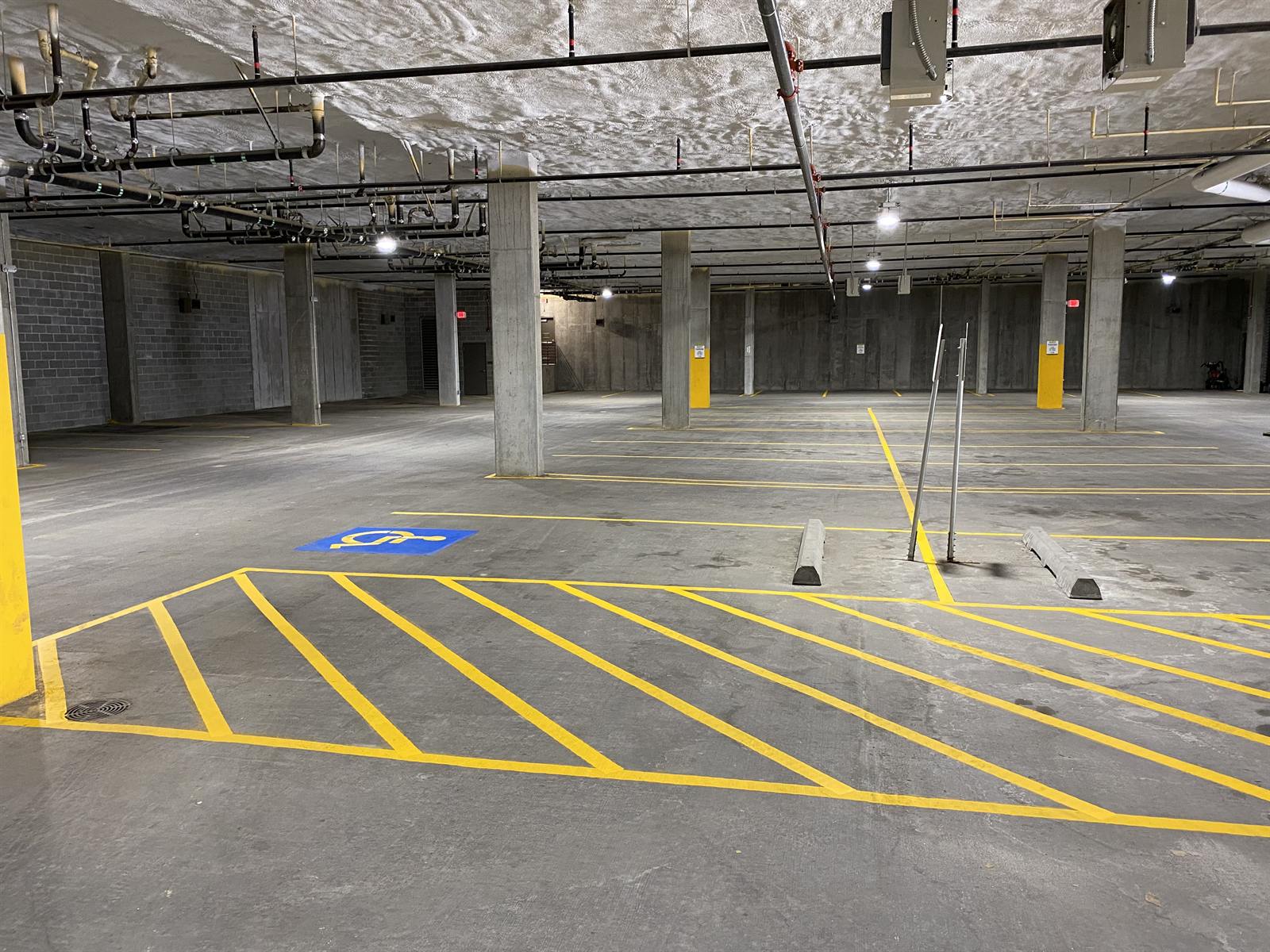
Why a Garage Isn't Just an Indoor Lot
Some of the biggest differences aren't about the painting itself — they're about the conditions the paint has to perform in.
Outdoor Lot
Asphalt surface, full daylight most hours, mostly straight-line tire roll on stalls, and sun/weather as the main cause of paint breakdown over time.
Parking Garage
Concrete surface, fixed artificial lighting at all hours, tight-radius turns that scrub paint at ramps and corners, and level-to-level wayfinding that an outdoor lot never needs.
Why It Matters
In a structure with no natural light and tighter sightlines, the paint is doing more of the safety work than it would outdoors.
Visibility Isn't Optional
Without sunlight filling in the gaps, worn or low-contrast paint can genuinely disappear under artificial lighting in a way it never would outdoors.
Blind Corners & Ramps
Tight turns and ramp transitions give drivers and pedestrians very little advance sightline — clear lane lines and arrows are what compensate for that lost reaction time.
Reduces Circling Traffic
Clear level and directional markings cut down on drivers slowly circling to find an open stall or their own car — both a convenience issue and a congestion and safety one.
Pedestrian Exposure
People on foot share the same tight aisles and ramps as vehicles in a garage, with less separation than a typical surface lot provides — markings that manage traffic flow directly protect them too.
Property & Tenant Image
For office buildings, hotels, hospitals, and mixed-use properties, the garage is often the very first and last thing a visitor experiences on-site — worn or confusing markings undercut everything else about the property.
Liability in a Confined Space
Collisions in a garage tend to happen at low speed but close quarters — unclear right-of-way markings at ramps and blind corners are a frequent, preventable cause.
When to Repaint a Garage
Because of the scrubbing wear at ramps and turns, garage markings often need attention on a shorter cycle than an outdoor lot's.
Wear at Ramps and Turns
Scrubbed, scuffed paint at tight corners and ramp transitions is usually the first place a garage shows its age, well ahead of straight-run stall lines.
Markings Are Hard to Read Under the Lighting
If lines or arrows are difficult to make out under the garage's actual lighting conditions, faded contrast — not the light fixtures — is usually the real issue.
Drivers Are Confused or Circling
Recurring wrong-way driving, near-misses at ramps, or complaints about finding a level or a car are common signs that wayfinding markings need to be repainted or added.
New Construction or a Reconfigured Deck
A newly built structure or a re-decked level needs a full first-time layout, planned the same way a new outdoor lot's would be, adapted for the structure.
Bring Your Garage Up to a Standard the Lighting Can't Undercut.
Free, no-obligation quote for parking garage striping, wayfinding, and repaints.